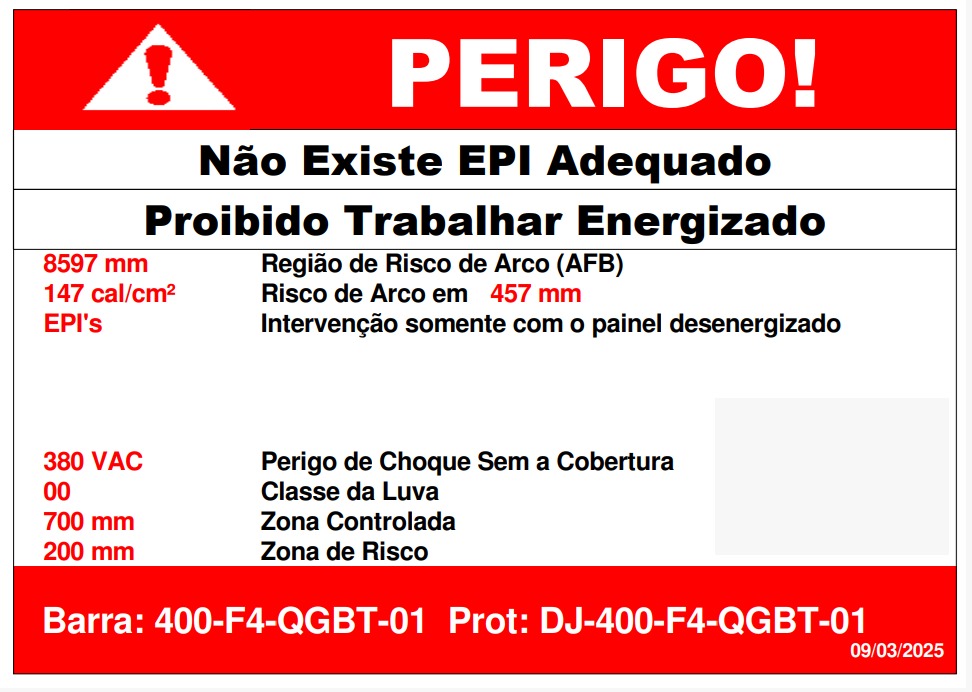
The incident energy analysis evaluates the arc flash risk in electrical installations, calculating the incident energy (in cal/cm²) at each point and determining the required protective clothing (PPE) by ATPV ≥ Ei. It is the basis for protecting workers against severe burns and for complying with applicable regulations.
Incident energy is the amount of thermal energy released by an electric arc that reaches a surface at a defined distance. The study models the electrical system, calculates this energy point by point, and evaluates the incident energy of each area. From that result, the appropriate PPE (with a compatible ATPV) and the warning labels affixed to the equipment are defined.
The updated NR-10 (in force from June 1, 2027) requires the arc flash risk analysis and organizes the selection of arc flash PPE into two paths: the Annex IV tables, valid only within the conditions they set, and the incident energy analysis, mandatory outside those conditions or when lower-category PPE is to be used. Without the study, there is no way to correctly define the protective clothing (ATPV ≥ Ei) or to demonstrate compliance during audits and expert assessments.
The incident energy calculation follows ABNT NBR 17227:2025, aligned with IEEE 1584:2018. The method estimates incident energy from the prospective short-circuit current, the fault-clearing time of the protection, the working distance, the electrode gap, and the equipment configuration. Small variations in these parameters change the result significantly, which is why data collection must be rigorous.
Want a quick estimate? Use our free incident energy calculator or discover the ArcFlash Platform.
The ATPV (Arc Thermal Performance Value) indicates the energy that a garment can withstand before the onset of a second-degree burn. With the incident energy calculated, we select flame-resistant clothing with an ATPV equal to or greater than the value at each point, ensuring adequate protection (ATPV ≥ Ei) at that point.
Under NR-10 (Brazilian Ministry of Labor Ordinance No. 737/2026), arc flash protective PPE is selected via the tables of Annex IV; outside the conditions of Annex IV, the incident energy analysis is mandatory. Item 10.11.2 sets selection by Annex IV, valid only for the conditions specified there — equipment, maximum fault current, maximum fault-clearing time and minimum working distance (item 10.11.2.1). For different equipment, a higher fault current, a longer clearing time or a shorter working distance, Annex IV does not apply (item 10.11.2.2) and the organization must perform the incident energy analysis per item 10.6.5 “a” (item 10.11.2.3).
The threshold is 1.2 cal/cm² (5 J/cm²). NR-10 (Annex I — Glossary) defines the “safe distance against the effects of the electric arc” — synonymous with the arc flash boundary (LAS) — as the distance at which incident energy reaches 1.2 cal/cm² (5 J/cm²), the value associated with a second-degree burn. This distance must be determined by an incident energy analysis.
There is no direct conversion from calculated incident energy into a category. The categories of Annex IV (Table III) express the minimum arc rating of the garment — ATPV or EBT of at least 4 cal/cm² (Category 1), 8 cal/cm² (Category 2), 25 cal/cm² (Category 3) and 40 cal/cm² (Category 4) — and not incident-energy ranges. When an incident energy analysis exists (the path required by items 10.11.2.3 and 10.6.5 “a”), the garment is specified by value: ATPV (or EBT) greater than or equal to the incident energy calculated at the working distance, per the Brazilian national standard ABNT NBR 17227:2025. Category assignment by table (Annex IV, Tables I and II) is based on equipment type and its conditions — not on the calculated Ei value.
The calculated values serve for verification and for PPE specification under the responsibility of a Legally Qualified Professional (PLH), per NR-10. They do not replace the formal incident energy analysis, the electrical design (item 10.4.12), or the required technical documentation.
Is an incident energy analysis mandatory?Under the new NR-10 (Ministry of Labor Ordinance No. 737/2026, in force from June 1, 2027), PPE may be selected from the Annex IV tables only within the conditions they set; outside them, the incident energy analysis is mandatory.
Which standard defines the calculation?ABNT NBR 17227:2025, aligned with IEEE 1584:2018, defines the incident energy calculation method.
Can incident energy be calculated for free?Yes — for a quick point-by-point estimate you can use our free incident energy calculator; the formal study, with a calculation report and labels, is prepared by our team.